
Navigating FOUNDER-EMPLOYEE EQUITY SPLITS, STOCK OPTIONS, and VESTING (pt. 1)
How do I handle equity distribution, stock options, vesting schedules, and the impact of corporate changes on my startup's equity structure?

Equity distribution and vesting are critical components of business or startup dynamics, particularly concerning founders and early employees. A well-thought-out equity split can align incentives, attract top talent, and drive growth. On the other hand, poorly planned equity arrangements can lead to conflicts, legal challenges, and strategic misalignments.
After reading this article, you’ll understand the meaning of equity, vesting strategies, key factors to consider when apportioning equity, the effects of corporate restructuring on equity stakes, and any other crucial factors.

What is Equity?
Equity is the value of the shares issued by a company. It is calculated when total assets are subtracted from total liabilities on a company’s balance sheet. The worthiness of equity is based on the present share price or a value regulated by the valuation professionals or investors.
Equity and Stock Options are not the same thing.
Equity represents a shareholders’ stake in the company while Stock Options give the recipient the option (not obligation) to buy the company shares at a specific date and price - usually less than or regardless of current market value. Stock options are used as non-cash compensation for talent and employees in lieu of a larger salary or as an incentive to stay with the startup regardless of uncertainties. That’s why it is called an “Employee Stock Option Plan”.
With stock options, you will not have equity or shares in the company unless and until you exercise your right to purchase the shares. Where you are unable to purchase the shares in your stock option at the set price, you can resell the option to the company. In this instance, the company will pay the employee the difference between the market value and the set price. Once a stock option has been exercised, the employee can continue to hold or sell the stock. Here, the company enjoys a right of first refusal, and transfers to third parties are restricted. However, these are all subject to the terms and conditions of the stock option plan.
Advantages of Stock Options include;
It’s a non-cash alternative to compensation where there are insufficient funds to recruit staff
It incentivizes an employee to work hard to achieve company growth
It fosters personal interest in the growth of the company because stock options upon grant have no monetary value, they are only valuable once the option is exercised. Therefore, the more valuable the company, the more profitable the stock options.
The stocks are tax-free until sold. When sold, they are taxed as capital gains rather than personal income.
Understanding Equity Splits: Founders vs. Employees
Determining Equity Split Among Founders
Founders often face the dilemma of whether to split equity equally or unequally. An equal split (e.g., 50/50 for two founders or 33/33/33 for three) can foster a sense of fairness and equal contribution. However, it may not accurately reflect differences in experience, initial capital contributions, commitment, or roles. An unequal split takes these factors into account, distributing equity based on each founder's relative value to the company.
Factors Influencing Founders' Equity Split:
Role and Responsibility: The distribution should consider the strategic importance of each founder’s role (e.g., CEO, CTO, CMO), contributions to the company’s intellectual property, valuable network or connections, and the ability to resolve future problems
Time Commitment: Full-time commitment versus part-time involvement should affect equity distribution.
Initial Capital Contribution: Founders contributing more in initial capital or assets may receive a larger equity stake.
Experience and Reputation: Experienced founders with a track record of success might command a larger share.
Risk Tolerance: Founders who assume more risk (financial or career) may be allocated more equity.
Employee Equity
For early-stage startups with limited cash flow, equity can be an attractive component of compensation packages for employees, incentivizing them to work hard and stay with the company. A typical approach is offering stock options, which give employees the right to purchase shares at a future date at a predetermined price.
Strategic Percentages for Employee Equity:
Early Employees (1-10 employees): Equity stakes for early employees typically range between 0.5% to 2%. Key hires or C-level executives might receive more, depending on their role and impact.
Mid-Level Employees: As the company grows, equity grants for mid-level hires may range from 0.1% to 0.5%.
Equity Pool Size: It’s common for startups to set aside 10-20% of the company's total equity for employees, known as the Employee Stock Option Pool (ESOP).
Typically, once the funding rounds are done, the equity splits may look like;
Founders: 20% - 30% divided among the co-founders
Investors and Shareholders: 30% - 50%
Employees and the Options Pool: 15% - 20%
Vesting Schedules: Aligning Interests and Minimizing Risks
What is Vesting, and Why is it Important?
Vesting is the process where an employee, founder, or advisor earns their equity over time, rather than receiving it all upfront. A vesting schedule is used by the startup to detail when and how the stock options can be exercised by its beneficiary. This vesting schedule mitigates the risk of someone leaving the company early and retaining a significant portion of ownership. There are different vesting schedules but the standard vesting schedule is 4 years with a 1-year cliff. This means that no equity is vested if the person leaves before one year. After the cliff, equity vests monthly or quarterly over the next three years.
Strategic Timing and Types of Vesting
Immediate Vesting: complete ownership of stock options granted to the employee is exercisable immediately after it is vested.
Cliff Vesting: complete ownership of stock options granted becomes exercisable in one big chunk after a certain date or period. If the employee leaves before the set date, the stock is forfeited and reversed to the company. It is usually no more than three years.
Graded or Gradual Vesting: is the most popular where stocks are vested incrementally over a period of time, usually three to four years. If the employee or co-founder leaves the company before the time is complete, the unvested stock is forfeited and reversed to the company.
The standard practice is to grant a stock option in a four-year vesting schedule with a one-year cliff. That is, one year after your hire or grant date, a portion of the stock vests after which the rest would vest slowly over three years (usually monthly or quarterly).
The vesting schedules apply to both employees and founders. Founder vesting builds investor confidence because they’re sure the founder has a long-term commitment to the company. Founders and Employees can negotiate shorter vesting periods, additional or performance-based vesting upon reaching certain milestones, and accelerated vesting where the stock options become exercisable before the set date has arrived or passed due to an event that accelerates its schedule
Factors to Consider in Equity and Vesting Strategies
1. Dilution and Future Financing
As startups raise additional funds through funding rounds, founders and early employees will face dilution, meaning their ownership percentage will decrease as new shares are issued to investors. It’s essential to account for this dilution when determining initial equity splits.
After each funding round, investors often require an option pool refresh to ensure enough equity is available to attract new talent. This can lead to further dilution for existing shareholders.
2. Legal and Tax Considerations
Before options are issued, the company undergoes a valuation to determine the fair market value of its common stock. This valuation affects the strike price (a fixed price at which the owner of the option can buy or sell the underlying security or commodity) of stock options. This is a legal requirement prevalent in many countries like the United States, United Kingdom, Nigeria, India, Canada, etc.
There is also the distinction between the type of stock option to offer and whether or not to make them early exercisable. The decision to allow early exercise (exercising options before they vest) can provide tax advantages to employees. Companies must also decide between issuing Incentive Stock Options (ISOs), which have favorable tax treatment but are limited in scope, and Non-Qualified Stock Options (NSOs), which have fewer restrictions but less favorable tax treatment.
3. Psychological and Cultural Impacts
Offering equity can create an ownership mentality among employees, leading to increased motivation and productivity. However, if employees perceive their equity grants as insufficient or unfair compared to their peers, it can lead to dissatisfaction.
Being transparent about how equity is allocated and the value of that equity is critical to maintaining trust and morale. Regular communication about equity policies, the company’s valuation, and how dilution affects shareholding is essential.
Conclusion
Developing a comprehensive equity and vesting strategy tailored to your startup’s unique needs and plans is vital. Founders and employees must carefully consider the equity split and vesting strategies to align interests, attract talent, and manage long-term growth.
By understanding the strategic timing, percentages, vesting conditions, and potential restructuring effects, companies can build robust equity frameworks that drive success while protecting all parties involved.
In the next publication, we will address the impact and effects of complex corporate restructuring efforts on the shares of founders and employees, so stay glued…
About Legal Bytes
We are Adune Legal’s weekly Newsletter, which simplifies the Law for Busy Executives, Entrepreneurs, and Tech Enthusiasts interested in the legal aspects of Business, Technology, and Intellectual Property.
We love emails from our readers— reply to this email and let us know your thoughts and suggestions.
WAIT!!!
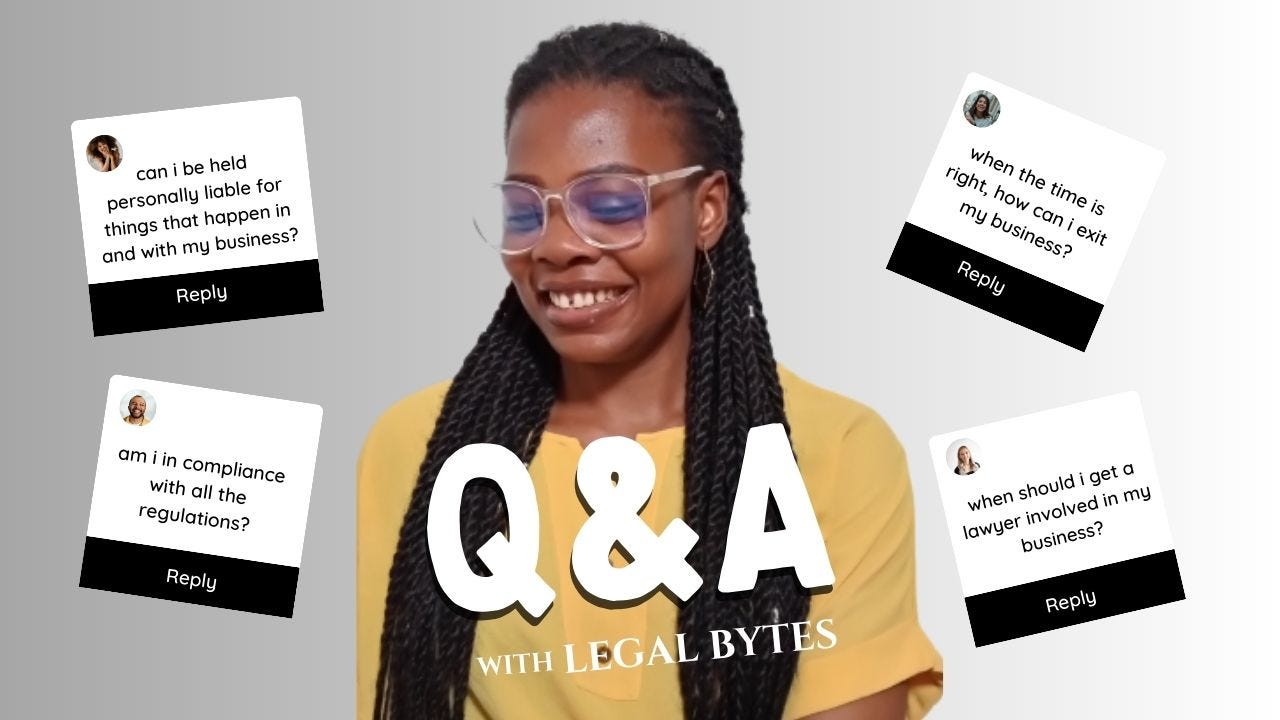
We're excited to announce that paid subscribers can access
Q&A sessions with Nneoma Grace via chats on Substack.
Detailed Legal Templates and examples to save you time and legal fees
Expert Interviews and Case Studies
Don't miss out on these perks - subscribe today and start enjoying it!
Thanks for reading Legal Bytes
Adune Legal’s Team
P.S. Like Legal Bytes? Please forward us to a friend.
P.P.S. Was this publication forwarded to you? Sign up here & see previous publications.